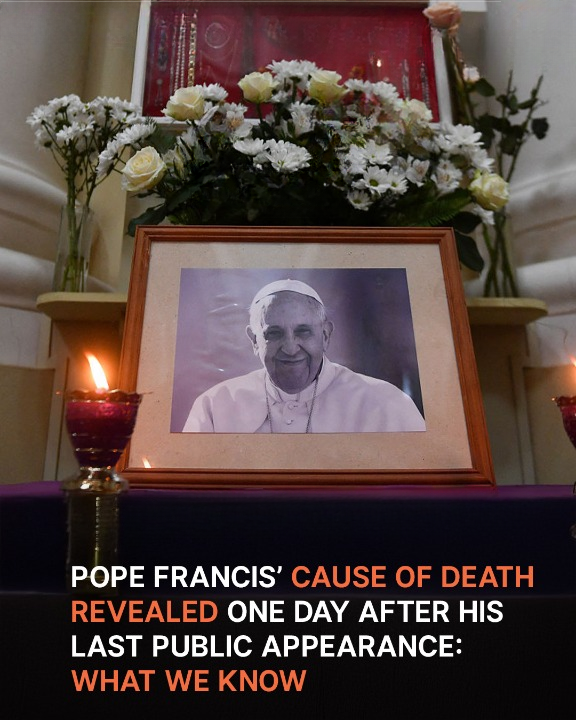
Just 24 hours after the world was stunned by the sudden passing of Pope Francis, the Vatican has confirmed new information, while mourners continue to gather in St. Peter’s Square — the very place he last appeared.
The Vatican has officially reported that Pope Francis died from a cerebral stroke, which led to a coma and ultimately to what they described as “irreversible cardiocirculatory collapse.”
As the news spread, grief poured into St. Peter’s Square. Pilgrims stood in quiet reflection, holding rosaries and praying. One mourner draped in an Argentine flag paid tribute to the Pope’s roots, while many stared at the empty balcony where he had last waved.
“He meant so much,” said Brigitte Thalhammer. “I’m heartbroken.”
When the rosary ended, the crowd responded with spontaneous applause — a final act of gratitude for the 88-year-old pontiff who had shaped the Catholic Church for over a decade.
Pope Francis’ death followed months of serious health issues that had sparked widespread concern. He had been hospitalized on February 14, 2025, at Rome’s Gemelli Hospital with severe pneumonia in both lungs. His care involved high-flow oxygen during the day and non-invasive ventilation at night.
Despite his condition, Francis stayed engaged with his duties. From his hospital room, he took part in the Roman Curia’s Spiritual Exercises via video and celebrated the 12th anniversary of his papacy with a small cake brought by his medical team.
Doctors described his condition as clinically stable, though complex. After 38 days in the hospital — a period during which his life was in jeopardy twice — he was discharged on March 23. He returned to Casa Santa Marta, the Vatican guesthouse where he lived, to continue recovering. He was advised to avoid public gatherings for two months, though his doctors remained hopeful about his full recovery.
But on Easter Sunday, April 20, Pope Francis made one final appearance.
Though he delegated the Easter Mass to Cardinal Angelo Comastri, he surprised everyone by emerging on the central balcony of St. Peter’s Basilica. He blessed the massive crowd with a smile and words of peace — a striking image considering his fragile state just weeks before.
His voice was clearer than it had been in prior public appearances. The crowd responded with cheers of “Viva il Papa!” and “Bravo!” as he waved gently, seated in a wheelchair. Aides surrounded him, one holding his microphone, as he delivered his blessing.
Later that day, he even rode in the Popemobile around the square, blessing children and waving to the faithful — a moment that now carries added poignancy.
Earlier on Easter, he had received a brief visit from U.S. Vice President JD Vance at his Vatican residence. The visit, intended as a holiday greeting, followed discussions with Vatican officials on immigration and global conflict — areas where he and the Pope had occasionally disagreed.
Less than a day later, on the morning of April 21, the Vatican announced that Pope Francis had passed away at 7:35 a.m. in his residence at Casa Santa Marta.
At 9:45 a.m., Cardinal Kevin Farrell formally shared the news. “His life was devoted entirely to the service of the Lord and His Church,” Farrell said, visibly emotional. “He led with courage, compassion, and deep fidelity to the Gospel.”
On the evening of April 21, a traditional rite was performed at the Pope’s residence, during which his death was officially certified, and his body was placed in a coffin inside the chapel. Cardinal Farrell oversaw the ceremony, which lasted under an hour.
The papal apartments in the Apostolic Palace, as well as the Pope’s living quarters at Casa Santa Marta, were sealed shortly afterward.
The Vatican has since confirmed that the Pope’s body will be moved to St. Peter’s Basilica on April 23, allowing the faithful to pay their final respects. Funeral arrangements are expected to be finalized after the initial General Congregation of Cardinals.
Social media has been flooded with tributes: “He is finally resting,” one user wrote. Another commented, “Rest in peace, Pope Francis. You will be missed.”
Just days earlier, in early April, Pope Francis made another unexpected visit — this time to St. Peter’s Basilica. A video shared by digital creator Jacob Stein (@cruxstationalis) showed the Pope, dressed informally in black pants and a striped wrap, being wheeled through the Basilica, oxygen cannula in place.
It was a rare, intimate look at the Pope’s frailty. He wasn’t in papal vestments. He wasn’t wearing his fisherman’s ring. He appeared not as a global leader, but as a man grappling with illness — and still choosing to show up.
The video sparked widespread discussion and mixed reactions. Some were touched by his humility, while others expressed confusion or concern over his non-traditional appearance.
“He doesn’t even look like himself,” one person observed. “He’s lost so much weight,” said another.
More reflective voices speculated on the symbolism: “It’s like the Church is slowly being dismantled,” someone mused.
But beyond the speculation, one truth stood out clearly: Pope Francis, to the very end, allowed himself to be seen — not as an untouchable figure, but as a vulnerable human being, bearing his suffering with dignity.